
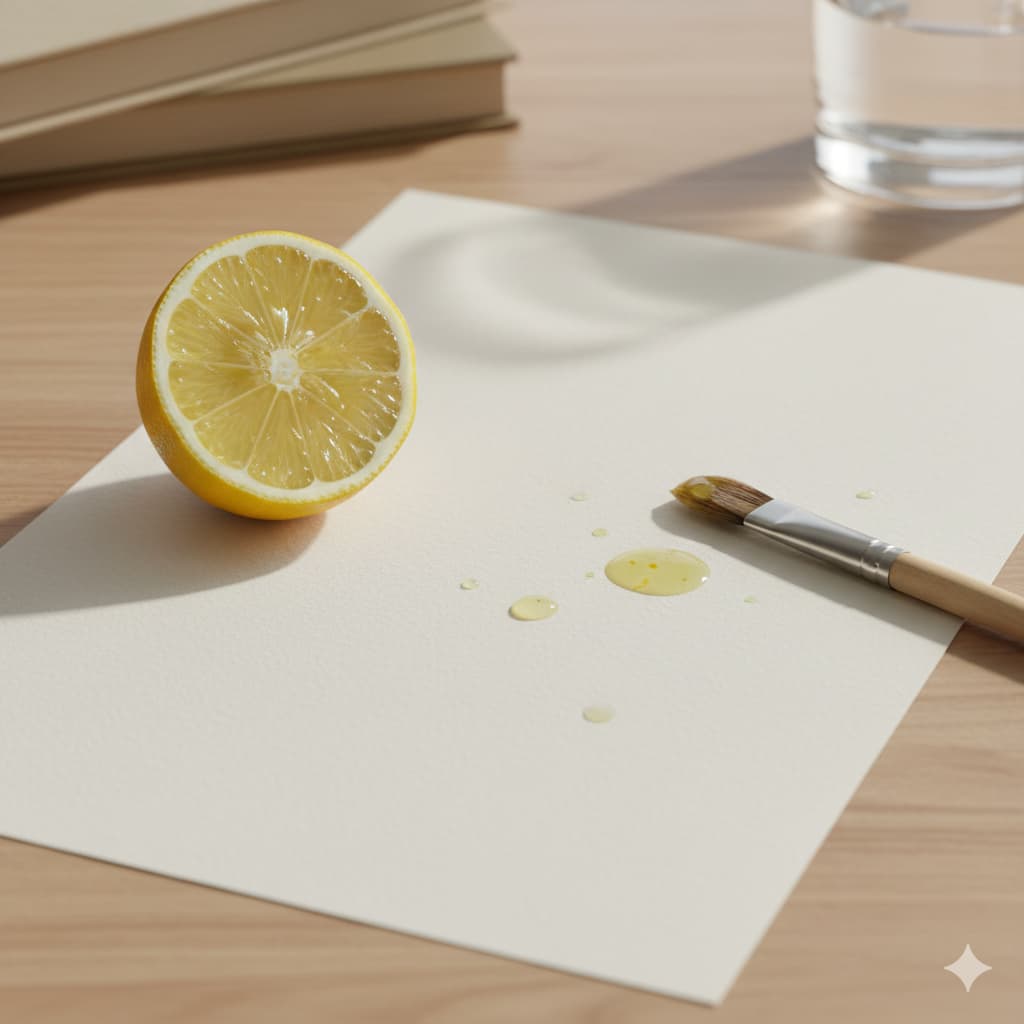
When I was a kid, my sister and I used to pass secret notes to each other. The trick was that you wrote something on a piece of paper in lemon juice, and the lemon juice dried clear. As far as anyone else was concerned, it was just a piece of plain paper. But those in the know (Kate and I) knew that if you ironed that piece of paper, the lemon juice would brown and the message would appear like magic. We thought we were super-spies.
It turns out that we weren’t the only people who knew about this trick. In 1995, McArthur Wheeler robbed two banks in Philadelphia, but was plainly visible to the cameras. When the footage was broadcast on TV, he was recognised by several people and within an hour, he’d been arrested. Wheeler was stunned, saying to the arresting officers “But I wore the juice!”. It turns out, Wheeler knew about the lemon juice trick too. He figured that if lemon juice could be used as invisible ink, then it would be the perfect disguise from cameras, so long as nobody ironed his face. Which… you can almost see the logic, except that it’s the lemon juice that becomes invisible, not the paper.
Wheeler had even gone so far as to test his assumptions. Before robbing the banks, he put lemon juice on his face and took a polaroid of himself, and when the photo developed, he couldn’t see his face. It’s probably hard to take a selfie when you’re eyes are stinging from lemon juice, but Wheeler interpreted this as hard evidence that the lemon juice trick would work, and went ahead with the plan.
Hearing about this story, social psychologists David Dunning and Justin Kruger conducted research into the phenomenon which has come to be known as the Dunning-Kruger effect. Their research found that the skills required to be good at something are the same skills required to know if you’re good at something. In other words, it’s pretty common to be unskilled and unaware of it.
It’s easy to laugh at Wheeler - and let’s be honest, we did. But in quieter, more respectable ways, we’re all doing the lemon juice thing. Of course, most of us aren't robbing banks in citrus disguise. But that same gap between what we think we know and what we actually know shows up everywhere.
I’ve noticed lately that whenever someone says ‘that’s a great question’, what they usually mean is ‘I don’t know’. And then there are two paths you can take from there. Some people say it to buy themselves enough time to come up with an answer that sounds plausible, as if they know the answer. Others people follow up with ‘I don’t know, let’s find out’. I like those people.
There’s something deeply human and wildly dangerous about our need to look like we always have the answers. To be right. To lock things in. Certainty feels like safety. Like a warm blanket. Or a loudly confident person on a conference panel about climate change who thinks ‘net zero’ means nobody has to do anything.
Certainty sells simplicity, in a world that is not. It’s stubbornly complex and full of nuance and contradictions.
But the more seductive certainty is, the more expensive it becomes. It rarely comes without a cost, but it does blind us to those costs. Certainty lets us stop thinking. It lets us default to what worked yesterday. It resists nuance, and it resents ambiguity. Certainty calcifies that past and calls it wisdom, which leads us to stagnate when we could evolve.
And it gets worse. Certainty that we’re right leads us to binary thinking where everything must be right or wrong, this or that, win or lose, them or us. Binary thinking is a great way to build a computer, but it’s a terrible way to live.
The cost of certainty is unquestioning loyalty to ‘how we’ve always done it’, defensiveness in the face of change, and separating us from one another. The moment we’re sure we’re right, we stop questioning. And the moment we stop questioning, we stop learning.
One of the most dangerous byproducts of certainty is the obsession with silver bullets – one answer to rule them all. But in complex or ambiguous times, real progress isn’t about finding the perfect answer, but about asking better questions, especially the uncomfortable ones.
The systems we’re part of – climate, health, justice, education, housing, the economy, organisations, aren’t puzzles to be neatly solved. They’re complex, adaptive ecosystems. And complex systems don’t respond well to blunt force certainty. They tend to fight back.
We need more people who are prepared to say, “That’s a great question. I don’t know the answer, but let’s find out”. If we can let go of the arrogance of needing to be certain, we can make space for the possibility of better.
Curiosity opens, certainty closes. Let’s reward humility over hubris, and celebrate those who get curious, make space for the unknown, and move forward anyway. Admitting you don’t know isn’t weakness. It might actually be the essence of wisdom.
We’re all walking around with lemon juice on our faces somewhere - unaware, overconfident, hoping no one switches on the metaphorical iron. The trick isn’t to avoid being wrong. That’s impossible. The trick is to realise when you might be, and not double down on the citrus.
What’s your lemon juice moment… where you were completely sure you were right… and turned out to be spectacularly wrong?