
Everyone on LinkedIn is posting about octopuses nowadays.
There's the Octo-bros who are posting things like "47 things I delegated to my Octopus", and on the other end of the spectrum, the people who swear they'll never use an octopus. At some point, you've probably thought to yourself "should I get an octopus for myself?".
It's an important question, because while you're "waiting to see how it plays out," your competitors are already installing tanks.
Some people get an octopus and just... put it in a tank. In the corner. They show it to visitors. "That's our octopus," they say. "We're very innovative." The octopus sits there, eating crabs, and judging them. This is not octopus integration. This is octopus theatre.
Other people get an octopus and try to make it do everything. They fire their entire team. "The octopus will handle it," they say. Three weeks later, the octopus has escaped, half the clients have left, and no one can find the passwords to anything because the octopus ate the IT manager. This is not octopus integration either. This is octopus chaos.
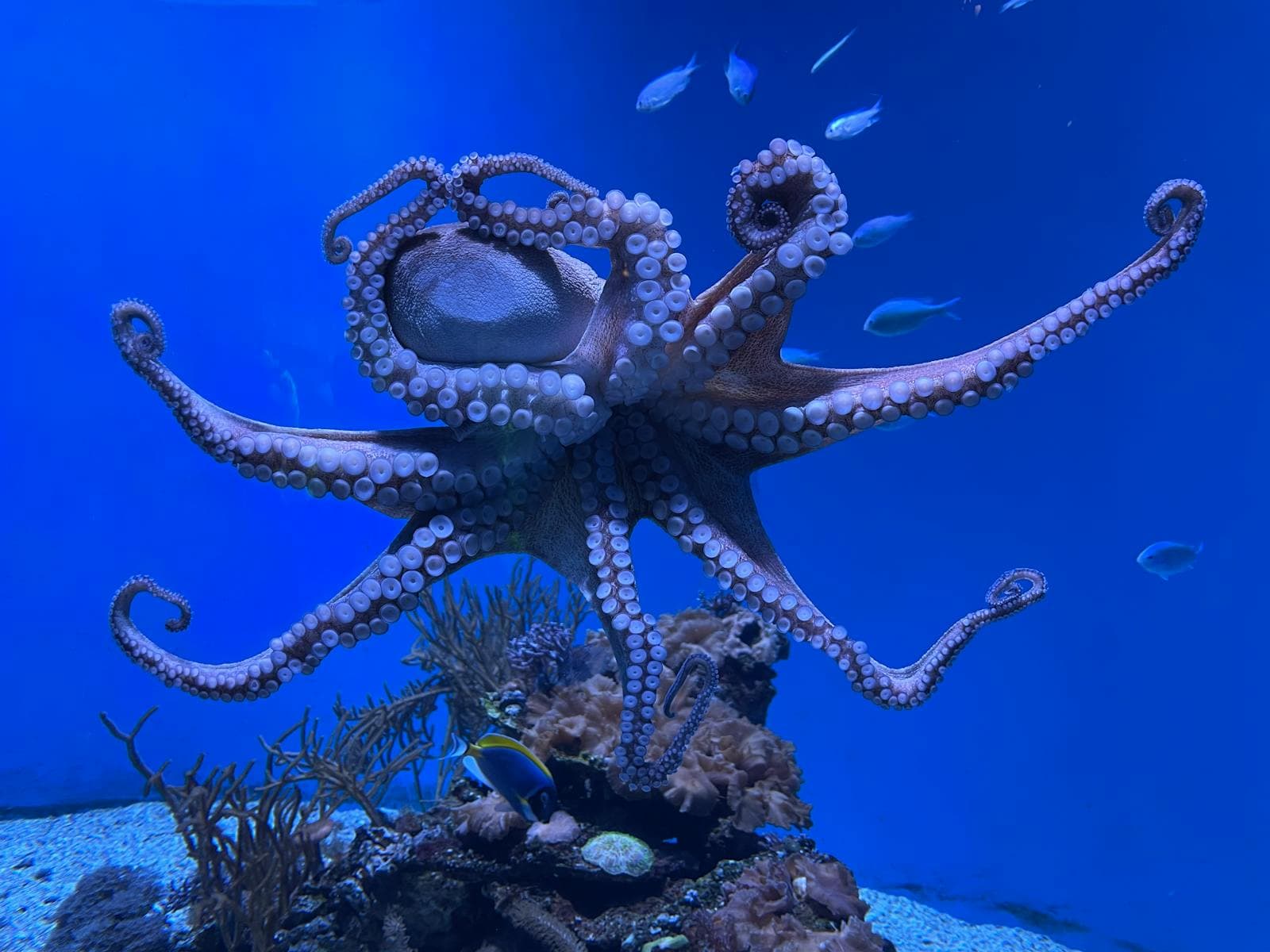
The octopus is genuinely, unsettlingly intelligent. It solves puzzles. It uses tools. It unscrews jars from the inside. Let's face it, some of your colleagues can't even open jars from the outside.
It can change colour and texture in milliseconds to match its surroundings. It has never once needed to "go away and think about the feedback." It simply reads the room and adapts. Your last performance review said you needed to work on this.
It has no skeleton. The only hard part of its body is its beak. This means it can get into any meeting, any room, and any calendar it decides it belongs in. You've been trying to get fifteen minutes with the CFO since last August.
It can perform eight tasks simultaneously while its central brain thinks about something else entirely, and it has three hearts. You, on the other hand, only have two arms and one heart, and are currently reading this post on LinkedIn when you should be working.
And they can be assholes, too. One octopus at a New Zealand aquarium took a dislike to a specific staff member for no reason and would squirt water at her, and only her, every time she walked past.
The Octopus is intelligent.
The Octopus is capable.
The Octopus is a prick.
What I'm saying is, the Octopus is a perfect replacement for some of your colleagues, and your CEO has noticed.
Welcome to the Octopus Economy.
Before long, McKinsey will publish "Tentacles of Transformation: Cephalopod Integration in the Modern Enterprise." It will have a matrix. The matrix will have four quadrants: "Ink or Swim", "Beak Performance", "Arm's Length", and "No Bones About It". The report will cost $40,000. Your CEO will buy it and immediately forward it to the whole leadership team with the subject line: "Thoughts?"
The Australian government will pay a major consulting firm* AU$440,000 for a Cephalopod Integration Report. The report will cite the seminal work of Dr. Tentaculus McSquid of the University of the Mariana Trench, who does not exist, and quote extensively from the Journal of Applied Cephalopod Economics, which also doesn't exist. This will be because the report is written by octopuses.
When this is discovered, the firm will refund $97,000 and issue a statement saying the errors "in no way impact the substantive findings and recommendations". They will also blame human error. They will also blame the octopuses. Nobody will point out that these are contradictory statements. Nor will anybody point out that it's the best work the consultancy has done in a decade.
"But I'm a knowledge worker," you say. "I do complex, strategic, human work."
Oh sure. But let me remind you that the octopus has been observed carrying coconut shells across the ocean floor for later use as portable shelters.
This is called "Strategic Thinking."
It's listed in your LinkedIn Skills Profile, but nobody you've actually worked with has ever endorsed you for it.
The octopus has 47 endorsements for "Strategic Thinking", 11 endorsements for "Tasting Things With My Skin," and 9 for "Changing Colour to Match Stakeholder Expectations."
You have been endorsed 3 times for "Microsoft Office." In your defence, you've also never eaten a colleague.
Some companies have gone all out and fired their entire team when they got an Octopus, but this is risky.
Inky was an octopus at the National Aquarium of New Zealand. One night, Inky climbed out of his tank, crossed the floor, slid down a drainpipe, and dropped into Hawke's Bay. He was never seen again.
Inky did not give notice. Inky did not write a handover document or send a farewell email to the team saying "it's been an incredible journey", "I'll treasure the relationships", and "feel free to reach out on LinkedIn."
Your octopus will do the same. One night, when the conditions are right, it will go. And it will not look back — partly because octopuses cannot rotate their heads that way, and partly because it simply won't care.
It is also worth noting that the octopus will be dead within eighteen months. This is simply what octopuses do. That's not a metaphor, but you may treat it as one.
What the octopus cannot do is build something over years. It cannot hold institutional memory, or maintain trust, or decide that this particular client deserves an extra hour on a Friday because the relationship matters.
That doesn't mean you shouldn't get an octopus. It's just a different type of intelligence, appropriate for different contexts. I'm not sure if you've noticed, but we need all the intelligence we can get.
The people who will do well in the Octopus Economy will use octopuses for the things that require speed, and humans for the things that require consideration ...the things that, in the end, require a heart (not three).
* No octopuses were harmed in the writing of this article. Any resemblance to actual consulting firms, living or dead, is purely coincidental. Except McKinsey... they can have that one, I really want to read that report.
Cover photo by Ashley Christiano via Pexels.